The end fitting is what determines whether the tensioning force from a ratchet lashing mechanism is transferred correctly to the load.
Choosing the wrong end fitting creates a weak point in the tie-down system. When a truck brakes suddenly or maneuvers sharply, the shock load concentrates on a single small point — bending the hook or tearing the webbing.
To prevent this, end fittings are engineered in several variants, each suited to different load conditions.
Understanding the 7 End Fitting Variants and Their Functions
Every type of cargo needs a different anchoring shape so the ratchet's tensioning force is distributed evenly. Here are the seven end fitting variants you need to understand so you stop attaching hardware at random on the job.
| End Fitting Type | Function | Ideal Anchor Point |
|---|---|---|
| 1. Double J-Hook (Claw Hook) | Universal; grips the edge of steel plates, distributing pulling load evenly. | Flatbed truck bed edge / lashing ring |
| 2. S-Hook (1153) | Compact, quick to attach/detach for light-to-medium capacity lashing. | Anchor hole / small-to-medium diameter pipe |
| 3. S-Hook (1804) | Thicker version for higher Lashing Capacity (LC). | Anchor bar / large diameter anchor hole |
| 4. Triangle Hook | Spring-loaded (snap latch) hook that closes automatically; safe for shock loads. | Vehicle anchor ring |
| 5. Delta Hook | Wide triangular base keeps webbing spread flat, preventing twisting. | Truck bed edge |
| 6. Delta Ring | Fully closed ring, no risk of slipping off; connected via shackle. | Vehicle body (via shackle) |
| 7. Claw Keep | Additional safety clip to keep the Claw Hook from shifting when slack. | Mounted directly on the Claw Hook |
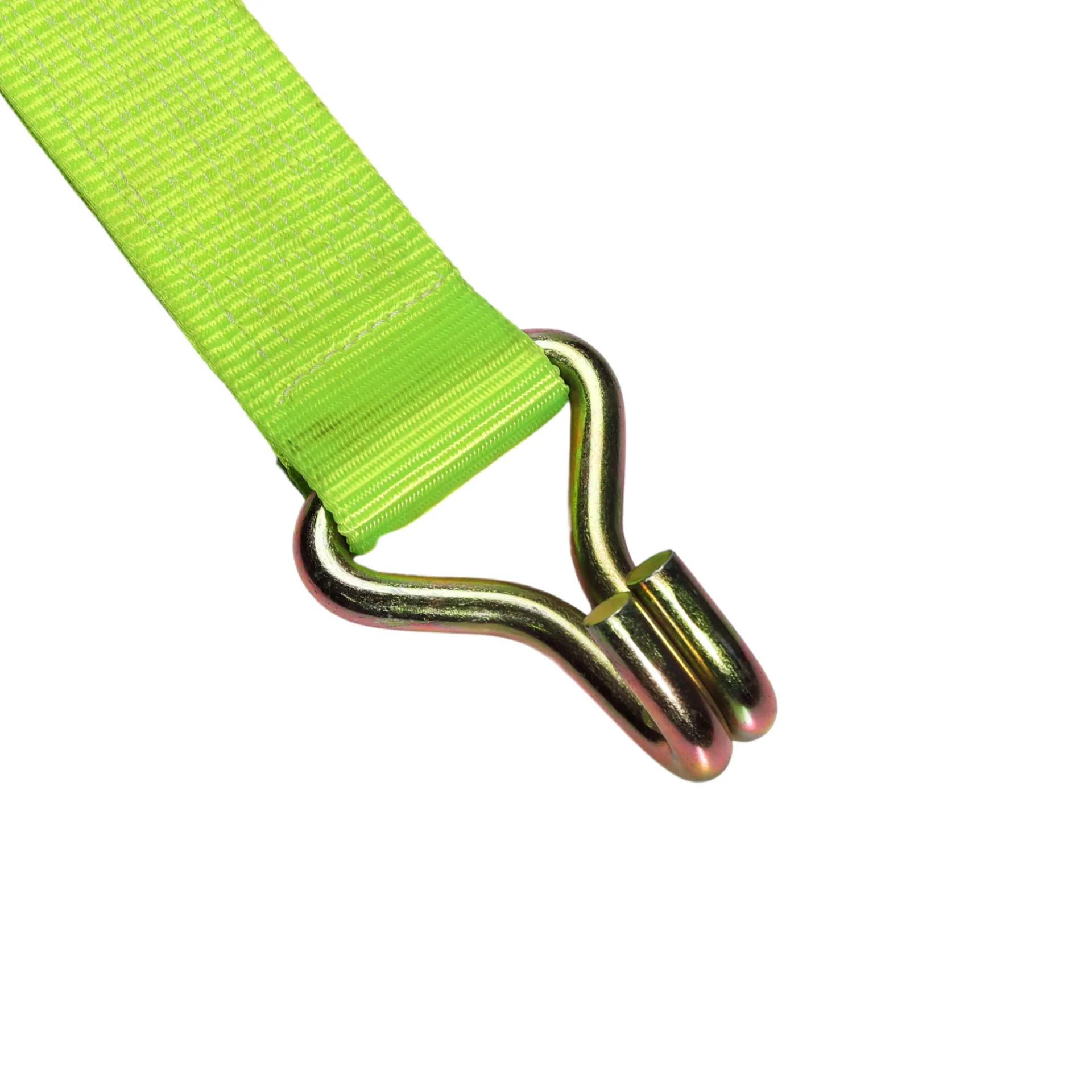
The Double J-Hook is a universal end fitting and the type most commonly seen on transport vehicles. Also known as the Claw Hook, it's made of two parallel solid steel bars bent into a J shape, purpose-built to hook onto the edge of a flatbed truck bed or a lashing ring.
The advantage of this dual-bar design is that it distributes pulling force evenly, minimizing the risk of the hook twisting when the truck hits potholes or uneven road surfaces.
The Double J-Hook (Claw Hook) has a short, sharply curved, claw-like profile designed specifically to grip directly onto the edge of a truck bed's steel plate.
- Short, compact shape that sits flush against the bed wall without taking up much space
- Strong grip directly on thin plate edges, with no anchor hole required
- Suited to flatbed vehicles where the bed edge is the only available anchor point
- Requires regular checks to make sure the grip position doesn't shift once the webbing goes slack
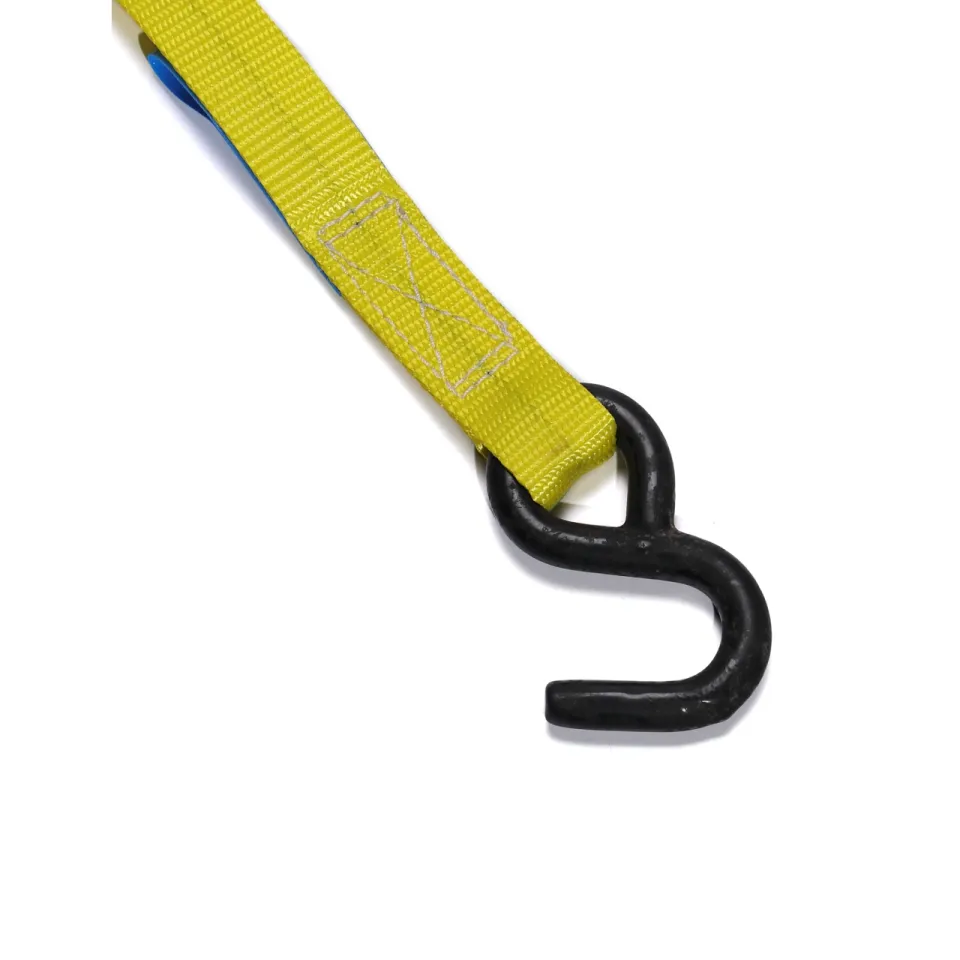
The S-Hook 1153 is a compact hook with two open curves forming an S shape, designed for everyday lashing needs at light-to-medium capacity.
Its compact, "just-right" sizing makes this hook highly versatile. It's commonly used on round anchor holes, tubular vehicle chassis frames, or small-diameter anchor rings without extra effort.
Because both ends are open, logistics crews can attach and remove the lashing strap quickly during loading and unloading, making this hook a favorite for high-frequency shipments.
- Two open hook ends, allowing fast strap attachment and removal
- Compact size, suited to small-to-medium diameter anchor holes or pipes
- Practical for daily transport vehicles at light-to-medium capacity
- Attachment doesn't require a wide hole clearance
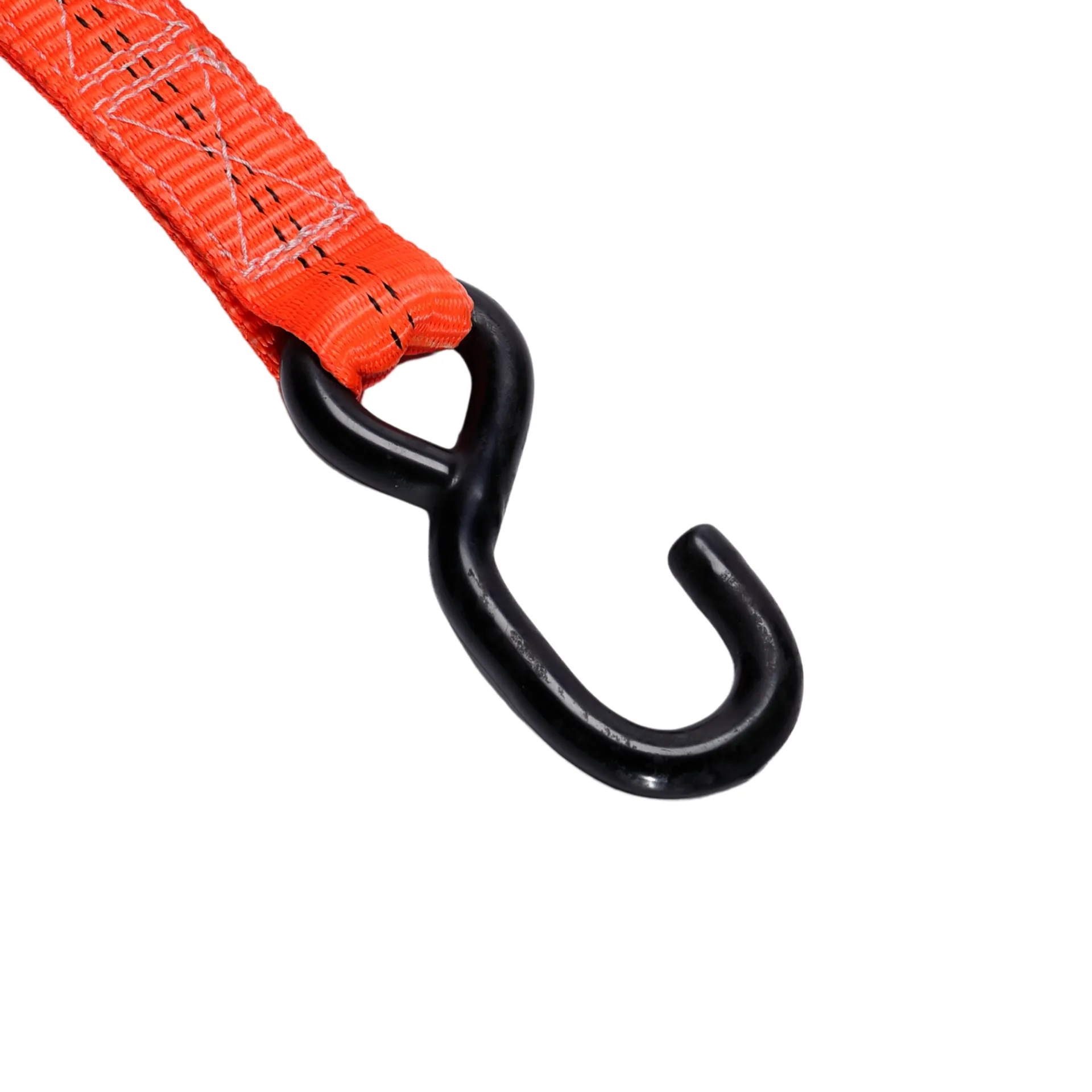
Unlike the 1153 type, the S-Hook 1804 features thicker steel construction and a wider curve. It's used in applications requiring a higher Lashing Capacity (LC).
Its basic shape still follows the same S-curve principle, but the larger dimensions let this hook grip large-diameter anchor bars or anchor holes commonly found on trailers or heavy-equipment transport vehicles.
Despite its larger size, the open design on both sides still keeps field installation quick and easy.
- Thicker steel construction for a higher load capacity (LC)
- Wider curve, suited to large-diameter anchor holes or anchor bars
- Used for medium-to-heavy cargo that needs a stronger anchor point
- Still flexible enough for quick field installation despite its larger size
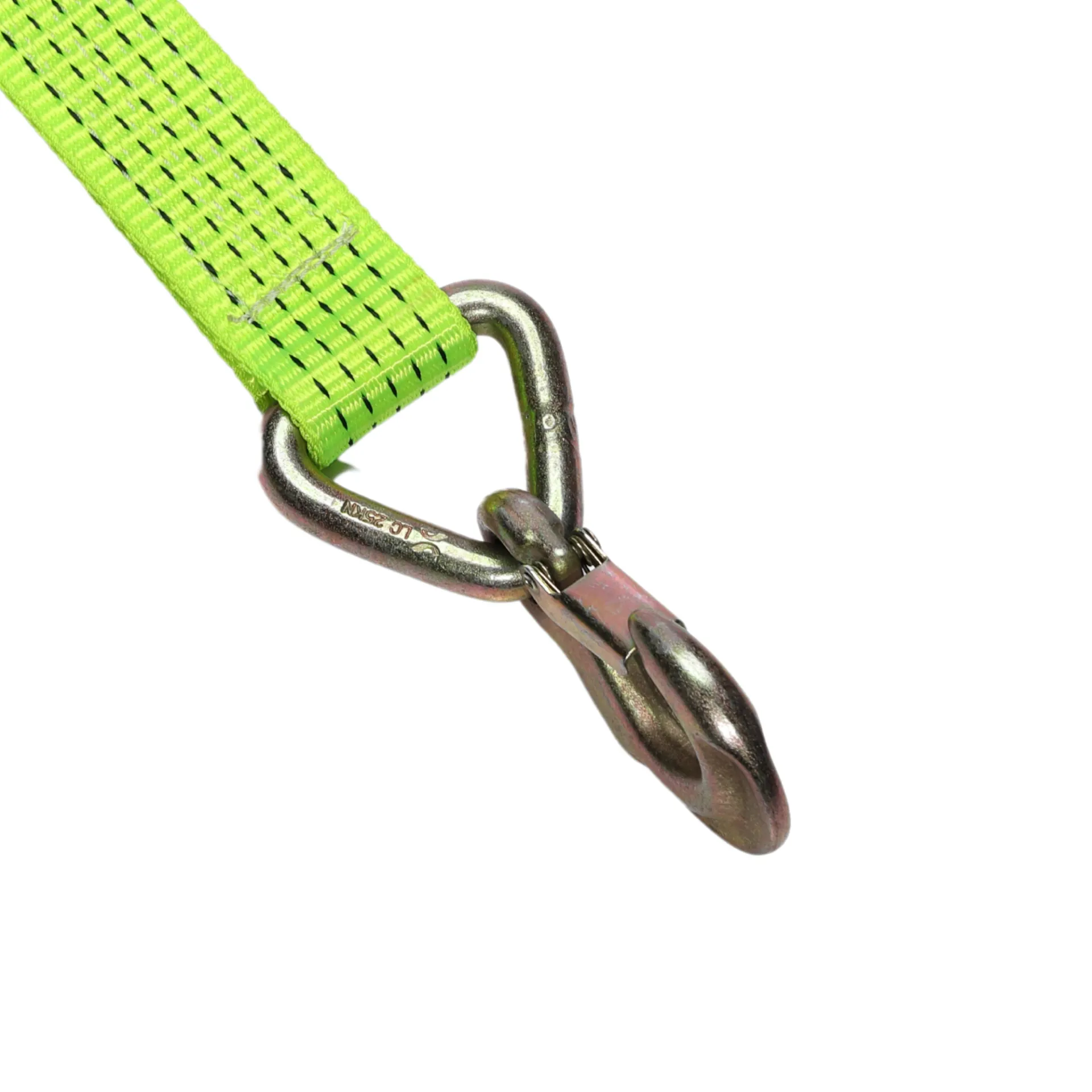
The Triangle Hook combines two safety elements in a single component: a closed triangular ring that serves as the force-distribution point, and a spring-loaded snap latch that closes automatically once hooked onto the anchor point.
This combination makes the Triangle Hook one of the safest end fittings in its class, since the spring gate prevents the hook from detaching on its own due to jolts or sudden slack during transit.
This feature is especially critical for the Diagonal Lashing method, where the strap absorbs dynamic shock loads from multiple directions and cannot afford even the slightest gap for slipping off its anchor point.
- Closed triangular ring distributes webbing tension evenly
- Spring-loaded gate closes automatically, preventing accidental detachment
- A safe choice for the Diagonal Lashing method, which experiences dynamic shock loads
- Ideal when combined with a shackle for specialized anchor points on cargo
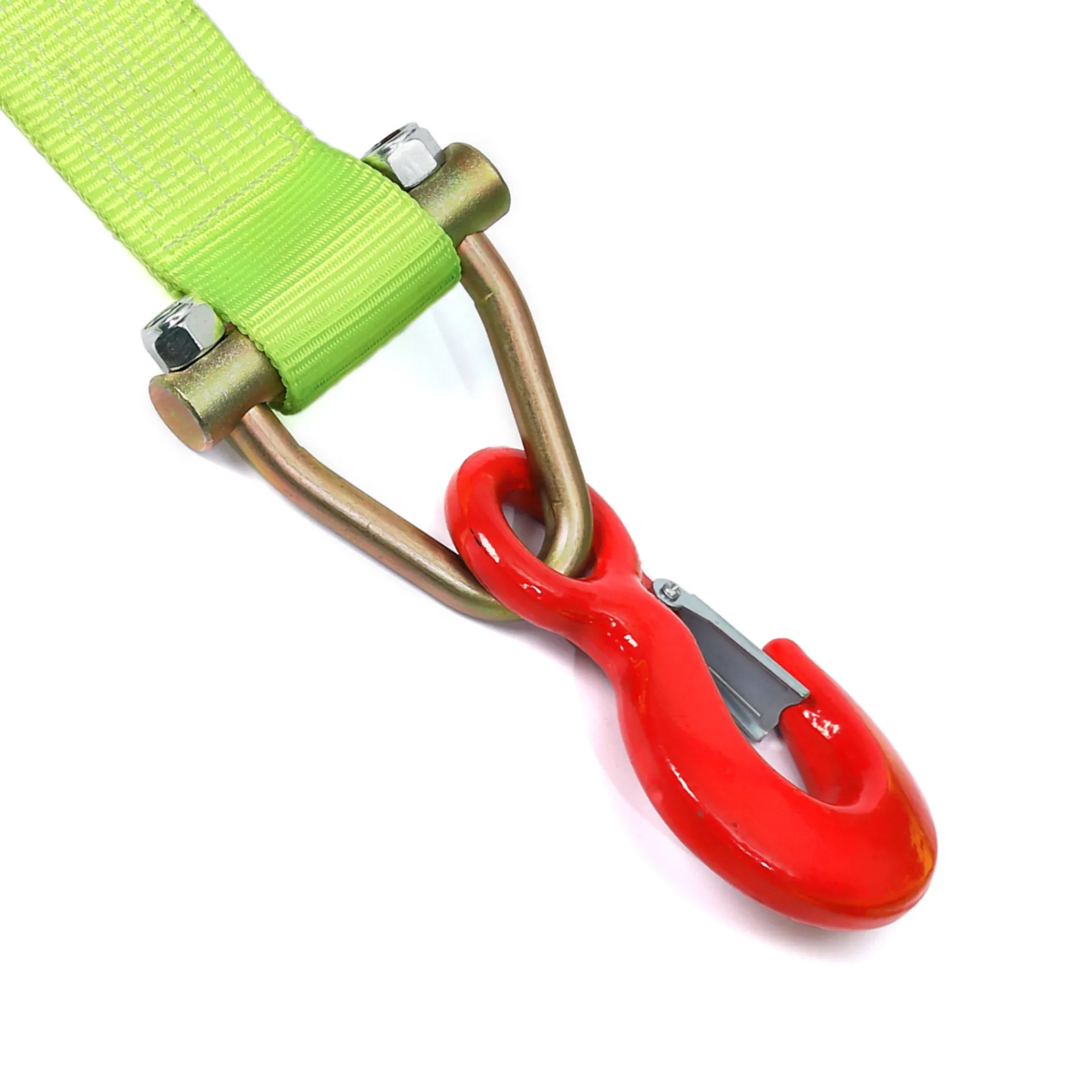
The Delta Hook is an end fitting with a wide triangular base fused directly to the webbing end, while the top remains an open hook for attaching to the anchor point.
The triangular plate base isn't just for looks — it's specifically designed to keep the webbing spread fully flat, preventing twisting when the ratchet pulls to maximum tension.
If the webbing twists at the attachment point, the fabric fibers bunch up on one side, creating a weak point that tears easily. The Delta Hook eliminates this risk by keeping the strap's full width open from end to end.
- Wide triangular plate base keeps webbing flat and untwisted
- Open top hook, easy to attach to anchor holes or truck bed edges
- Ideal for the Tie-Down method, since the pulling direction tends to run straight top to bottom
- Suited to cargo with a solid base surface and a sturdy structure
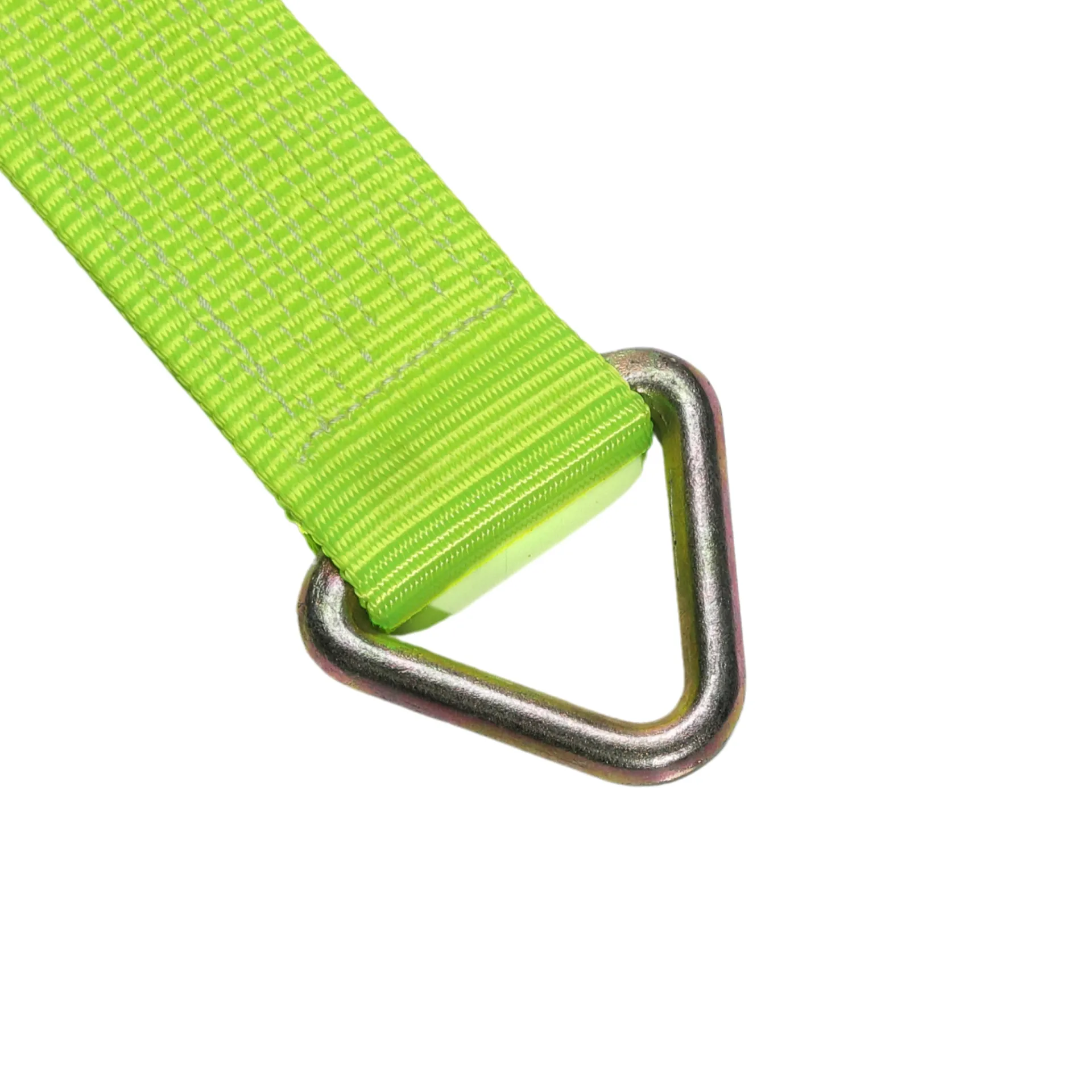
The Delta Ring (type 20004) is a full triangular ring with no gap at all — completely closed. Because it has no opening section, the risk of the hook detaching from point loading or sudden jolts is effectively eliminated.
This ring is generally not hooked directly onto the vehicle body but connected via a shackle as an intermediary, so the combination creates a highly stable anchor point that distributes webbing tension evenly across the strap's full width.
- Fully closed ring with no gap, so there's no risk of detachment under shock load
- Distributes webbing tension evenly across the strap's full width
- Typically connected to the vehicle body or cargo using a shackle
- Suited to the Direct/Diagonal Lashing method at dedicated anchor points
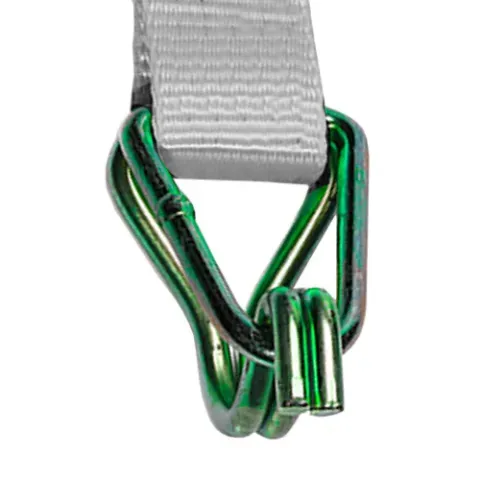
The Claw Keep is not a standalone hook; it's an additional safety component paired with the Claw Hook.
Its construction consists of two interlocking metal pieces — one curved section resembling the claw hook, and another section that acts as a safety clip that clamps behind it.
The Claw Keep's main function is to stop the Claw Hook from shifting or slipping out of its grip position when the lashing strap experiences momentary slack from vehicle jolts on rough roads or sharp turns.
Without this locking component, the claw hook's grip — which only "bites" the edge of the truck bed plate — risks detaching on its own when webbing tension momentarily drops, making the Claw Keep an important second layer of security in the ratchet lashing system.
- Paired with the Claw Hook, not a standalone component
- Acts as a locking clip to keep the grip position from shifting
- Prevents the hook from detaching during sudden webbing slack
- An added safety layer, especially for travel on uneven roads
Guide to Reading the Lashing Strap Label (Blue Label)
Every legally manufactured pair of ratchet lashing straps meeting international workplace safety standards must carry a textile information label, typically blue (per EN 12195-2 for polyester material). Logistics crews shouldn't just use the equipment blindly — they need to be able to read the load capacity indicators on that label to keep the cargo safe.
Here are three critical capacity terms always found on the label:
Lashing Capacity (LC)
The maximum tie-down or pulling force allowed for use in a straight-line lashing system. Units are typically Newtons (N) or Decanewtons (daN). For example, an LC value of 2,500 daN means the strap can safely withstand a direct pulling force equivalent to 2,500 kg of static load.
Minimum Breaking Strength (MBS)
The absolute maximum limit at which the webbing or metal component will fail structurally — i.e., break. This MBS value typically carries a safety factor of 2:1 relative to the stated LC value.
Standard Tension Force (STF)
This value indicates the residual pre-tension left in the strap after the ratchet lever has been pulled to maximum by manual human effort. The higher the STF value on the label, the tighter the strap presses the cargo down onto the truck bed floor — meaning greater friction force and less chance the load will shift.
As a safety pioneer, ratchet lashing variants are divided into three categories depending on the situation and conditions. Here's a guide table for ratchet lashing types:
| Ratchet Category | Load Capacity | Features & Material Characteristics | Applications & Use |
|---|---|---|---|
| Light Duty | Up to 1,000 kg (max. 1,000 daN) | Complies with international standard EN 12195-2. Lightweight and practical. | Suited to cars, vans, and small trucks. A safe solution for daily logistics, in-city loads, or box-bed retail transport. |
| Medium Duty | Up to 5,000 kg (max. 5,000 daN) | Epoxy resin coating (impact and weather resistant). ABS (Anti-Belt-Slip) system. | Designed for trucks and larger cargo. An ideal, economical choice for friction-based tie-down during transport. |
| Heavy Duty | Up to 10,000 kg (extreme loads) | Premium patented Double Slider (half-tooth) mechanism. Tensioner lever with automatic lock. ABS system. Special low-elasticity, wear-resistant webbing (max. 4%). | Built for heavy machinery and industrial transport (such as precast concrete or heavy equipment) to guarantee maximum safety. |
The Danger of a Hook Tip Bearing the Entire Load
Point Loading occurs when an open-end fitting (such as a Double J-Hook or S-Hook) doesn't seat properly and instead only catches on the sharp tip of a steel bar or a hole that's too small. As a result, the entire pulling force tightened by the ratchet bears down on just that pointed tip of the hook. When the vehicle brakes suddenly, the massive shock load instantly bends or snaps the steel end fitting, since the material is forced to bear load outside its safe support point.
Basic Rules for Attaching an End Fitting Correctly
To avoid the dangers of Point Loading, make sure the innermost curve of the end fitting sits fully and completely around the vehicle's anchor bar. The hook should never hang loosely or get obstructed by other structures. If the anchor hole is too small for your hook size, never force it — switch immediately to a more suitable SpanSet end fitting variant (such as a Single J-Hook, or use a shackle as an intermediary).
Measuring the Tolerance Limit for Hook Mouth Deformation
An end fitting that has previously carried an overload from a cargo jolt typically shows deformation symptoms — the hook's mouth opening widens beyond its original size. Per international workplace safety standards, if the deformation or opening stretch of the end fitting (such as on a Double J-Hook or S-Hook) exceeds 5% of its original factory dimensions, that component is legally deemed unfit for use and must be replaced for road safety.
The Point Loading Phenomenon: The Fatal Mistake That Often Snaps Hooks
Choosing the right end fitting component is just the first step; disciplined installation practice is what ultimately determines whether the hook end becomes a fatal weak point once the ratchet's force is applied.
Safety Guide: Avoiding Point Loading on End Fittings
The Danger of Point Loading (Single-Point Bearing)
Condition: An open hook (Double J-Hook/S-Hook) doesn't seat properly and only catches on the sharp tip of a steel bar or a chassis hole that's too small.
Impact: The entire pulling force bears down on the hook's pointed tip. Under sudden braking, the shock load instantly bends or snaps the steel, since it's forced to bear load outside its safe support point.
Basic Rules for Correct Installation
- Make sure the hook's innermost curve sits fully and completely around the anchor bar.
- The hook must never hang, tilt, or get obstructed by other structures.
- Never force a hook into a hole that's too narrow. Switch immediately to a more suitable end fitting variant (such as a Single J-Hook) or use a shackle as an intermediary.
Tolerance Limit for Hook Mouth Deformation
A hook that has previously carried an overload will show deformation (a widened hook mouth). If the end fitting's opening stretch exceeds 5% of its original factory dimensions, the component is deemed unfit for use and must be replaced for road safety.
Tie-Down vs Diagonal Lashing: How to Distribute Tension Correctly
Choosing the right end fitting is only half the job. Broadly speaking, field lashing methods fall into two main systems: the Tie-Down method and the Diagonal Lashing method. These two methods work in opposite ways when it comes to distributing load onto the end fitting component. Here's a comparison table:
| Comparison Criteria | Tie-Down Method (Friction Lashing) | Diagonal Lashing Method (Direct Lashing) |
|---|---|---|
| Main Working Principle | Relies purely on surface friction by pressing the cargo down as hard as possible toward the bed floor. | Restrains cargo directly from multiple angles using a physical restraining wall formed by the strap. |
| How the Strap Works | The webbing doesn't restrain forward/backward movement directly; instead, it multiplies downward pressure so the cargo doesn't shift easily. | The strap tensions instantly to absorb the vehicle's dynamic jolts (rear straps resist sudden braking, front straps resist acceleration). |
| Strap Positioning | Stretched over the top of the cargo (from a left-side anchor point, across the top of the load, down to a right-side anchor point). | Pulled at an angle or diagonally from the cargo's anchor point straight to an anchor point on the truck bed floor. |
| Recommended End Fitting | Open hooks are ideal: Double J-Hook, S-Hook, or Delta Hook (since the pulling direction is constant and straight). | Closed hooks are mandatory: Delta Ring or Triangle Snap Hook combined with a shackle. |
| Specific Restrictions | Avoid use on overly slippery cargo base surfaces or fragile/crushable cargo structures. | Open hooks are strictly prohibited, as they can jump loose under shock loads. |
| Ideal Cargo Characteristics | Suited to cargo with a sturdy, solid structure and a grippy base surface. | Required for extreme, heavy, high-value cargo such as heavy-equipment chassis holes, industrial generators, or new vehicle bodies. |
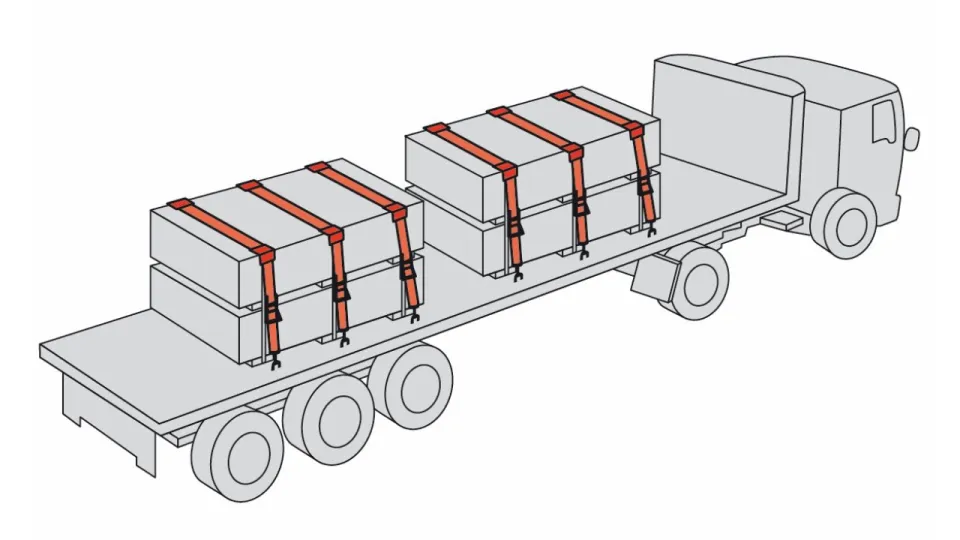
1. Tie-Down Method (Friction Lashing)
The Tie-Down method is the most common tie-down system, the one you see most often on the highway. It works purely on surface friction. In this method, the lashing strap is stretched over the top of the cargo — starting from an anchor point on the truck bed's left side, crossing over the load, down to an anchor point on the right side.
When the ratchet lever is tightened, the webbing doesn't restrain the cargo from moving forward or backward directly. Instead, it presses the cargo down onto the truck bed floor as hard as possible. That downward pressure multiplies the friction force between the cargo's base and the truck bed, locking the load in place so it doesn't shift easily.
For this method, open hook variants like the Double J-Hook, S-Hook, or Delta Hook are ideal choices, since the strap's pulling direction stays constant and runs straight from top to bottom. The Tie-Down method is best suited to cargo with a sturdy, solid structure and a grippy base surface.
2. Diagonal Lashing Method (Direct Lashing)
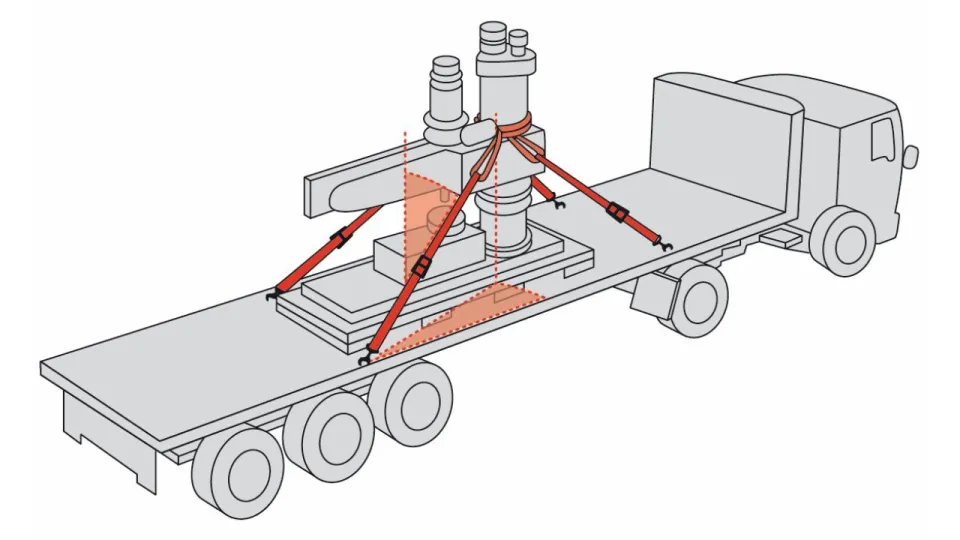
Unlike Tie-Down, which presses cargo downward, the Diagonal Lashing (or Direct Lashing) method works by restraining the cargo directly from multiple angles. This system doesn't run the strap over the top of the cargo; instead, it hooks the end fitting directly onto a dedicated anchor point built into the cargo itself (such as a heavy-equipment chassis hole, an industrial generator, or a new vehicle body). From that cargo anchor point, the strap is pulled at an angle or diagonally toward an anchor point on the truck bed floor.
The main goal of this method is to create a physical restraining wall out of steel or polyester strapping. When the truck brakes suddenly, the rear strap tensions instantly to keep the cargo from sliding forward. Conversely, when the truck accelerates, the front strap takes over the restraining job. Because this method directly counters extremely dynamic vehicle jolts, using open hooks is strictly prohibited.
For the Diagonal Lashing method, closed end fitting variants such as the Delta Ring or Triangle Snap Hook, combined with an additional shackle, are mandatory. This ensures the hook has absolutely no gap through which it could jump loose under a massive shock load during transit.
Frequently Asked Questions About Cargo End Fittings
Boost Cargo Safety with SpanSet Indonesia
SpanSet Indonesia provides quality lashing equipment, including ratchet lashing straps with a wide range of end fitting variants. Engineered to the highest quality standards for optimal results.